

By Gavin Murphy


Fall
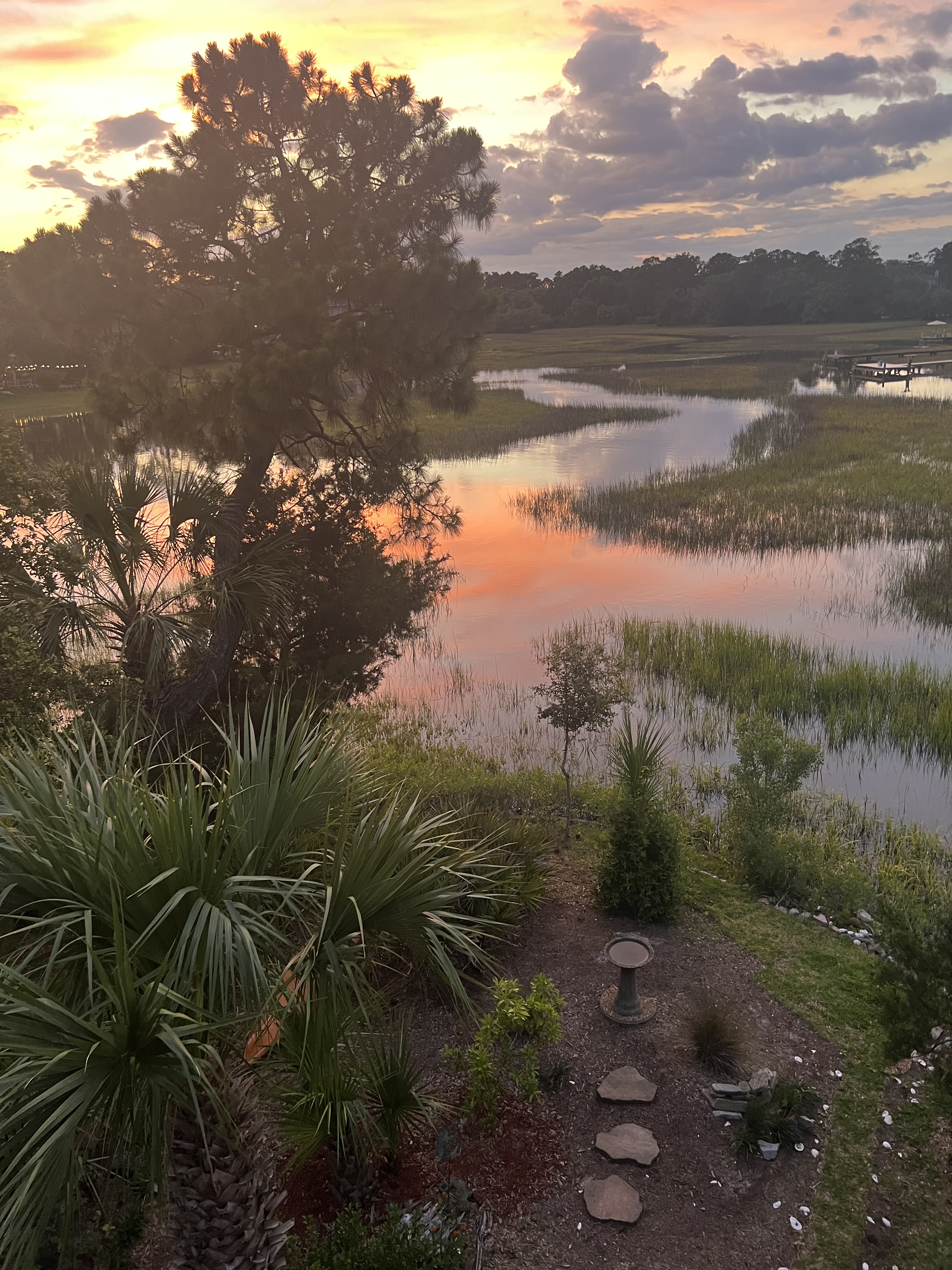
The spartina has bloomed
small white flowers that
will provide food for
the birds and also seed
the marsh itself. Fall colors
will come to the marsh as
the cordgrass turns a
mellow golden yellow.

Splashes of brighter yellow
are provided by blooming goldenrod.
Another plant believed to have medicinal
properties, its flower tipped stalks
are scattered here and there at
the edge of the marsh.

Migrating monarch butterflies
congregate in the crimson bottlebrush
trees. The birds leave the butterflies
be because their diet as caterpillars
made them toxic to prey on now.

I refill the bird bath and retreat.
In short order a crow appears.
He has no reason to fear me.
He already knows who I am.
The bald guy who fills the bird
bath. A good human. But crows
are too smart not to fear humans.

And Saint Francis I am not.

When the crow spots me still nearby,
he gives me the hard eye before
spreading his powerful black wings
and taking off.

The other birds who frequent the
bird bath know who I am too.
They too are wary.

They often come in pairs,
or even a small flock.
Usually one or more stand
sentry. Hiding in the trees.
Watching for a hawk,
or a cat, or a snake.
The birds live in constant
danger, from above, from
below, from anywhere
at any time.

But they still have the
heart to sing.

My wife is up early,
sitting outside on the deck,
listening as a pecking
woodpecker greets the sunrise.

A pair of egrets swoop
low over the deck.

Some doves emerge
from the undergrowth.

My wife is thinking
about her mother,
who is near death
in hospice.

Blue jays bustle
in tree branches.
There’s much chatter
among the jays.

It seems to my wife
there is an unusual
amount of bird activity
this morning.

A pair of cardinals
appear at the birdbath.

My wife recalls hearing a
song that says birds,
especially cardinals,
are sent by the spirits
of deceased loved ones
to reassure the living
they are doing fine
in the afterlife.

The phone rings.
Mom has passed away.

Fisherman come to the marsh
and cast seine nets to catch
small fish for bait.

While most of the birds don’t
get too close to humans
some of the egrets and herons
have learned that fishermen
and crabbers can be good
for a handout, tossing them
a spare shrimp or some
cut up fish used for bait.

Some don’t wait to be fed.
They see their opportunity
and steal whatever they can
from the fisherman's bucket.

The fish in the marsh -
typically mullet - but
sometimes bigger species,
don't often get a free lunch,
and what looks like a free lunch
may contain a hook.

Occasionally, a fish leaps
from the water to make a
modest meal of a tiny bug
that came too close to the
surface.

The concentric circles left
by airborne fish splashing down,
attract the osprey, which has
super sharp even ultraviolet vision,
specifically adapted for hunting fish.

The fish that swallowed the bug
finds itself airborne again,
this time gripped in the
osprey’s fish hook like talons.

The king snake, lustrous black
and banded by yellow,
crawls slowly in the yard.
Aware that it is exposed
it pauses to assess the
situation, realizes there’s
a human in the vicinity.
Then, moving faster,
it slithers out of sight.

Somehow, it too survives
the encroachment of people.


I think the varmint is an
armadillo. (Dasypus novemcinctus)
Somehow related to sloths and
anteaters… But, since I’ve
never seen the son of a …
I’m not sure.

Finches? I use the term
loosely, because an
ornithologist I am not.
When a tiny bird lands
on the edge of the birdbath,
I scramble for the binoculars.
Try to quickly focus.
Looks like a finch.
I find the bird guide.
Check the index for finches.
Realize I’m in the Scientific
Index… Finally get to the
page. “Green plumage…
black crown …
yellow wings and tail…
I lift the binocs -
but the bird is gone.

In a little while tiny
sparrows appear.
Lilliputian sparrows
seem to like the cedar
trees. The birds are so
small they almost look
like - finches.

I keep saying I’m gonna
get a good camera, one with
a zoom lens. So I can
take a photo. Use that
photo to identify the bird…
There’s probably an app
for that too.

But until I get that lens
and that app, whenever
a tiny bird finds the birdbath,
whatever diminutive avian
species it actually might be...
It’s a finch.

A raccoon swims across the
marsh in broad daylight.
Usually they come out at night.
It must be something important.

I’ve never really wanted to harm
an animal but the varmint…

Green anoles - Anolis carolinensis -
are a native species of lizard,
almost florescent green in color,
sometimes turning brown
when they are stressed.
Though they can change colors
they are not true chameleons.

They are everywhere in our vicinity.
Hunting for bugs on the plants.
Perching on rocks. Climbing up
the trees. Clinging to the walls
of the house.

They frequent our deck,
which appears to be prized
territory, given that it gets a lot
of sunlight and has a great view
of the marsh. Like all reptiles,
anoles enjoy sunbathing.

The males spend a lot of time trying
to claim the deck as their territory,
seeking to intimidate each other
with aggressive displays of head
bobbing and puffing red dewlaps,
a bladder like air pouch under
their necks. They are pretty fearless
little guys, even giving the dewlap
warning to humans who cross
their paths.


I remember as a kid being at
the circus in the city where one
of the wandering vendors was
busy selling anoles as pets.
The hapless creatures were
leashed to a board with string
around their necks and small
safety pins.

They cost a buck apiece and
looked dejected, with sad eyes,
their bright green color muted,
mottled. I felt sorry for them
and begged my parents to
let me rescue one or two
by buying them.

They said no.

Not as numerous as the anoles,
but still abundant are the skinks,
their smooth lizard skin almost
metallic dark blue. Sometimes
with racing stripes. They slither
quickly from hiding place to
hiding place, empty plant pots
being a favorite.

(Did I say they eat bugs?)


The geckos emerge in darkness,
strange, translucent, almost albino,
attracted to light. No eyelids.

They crawl up the stucco walls with feet
that are like suction cups.

(They’re feet are not really like
suction cups but actually are
covered in tiny hairs with
funny names that use
something called Van der Waal forces
that involve electrons and molecules,
all too complicated to explain
here. The geckos also seem
to be able to go through walls
as they are another critter that
manages to get inside the house.)

Geckos also like to hide
in the compost pile,
so I have to be careful
not to chop them up
when I use a shovel
while digging in there.

(Not native. Believed to have
come into the country
on cargo ships, maybe from
the Mediterranean region.)

At sunset the swallows dance in the sky…
They’re really
just eating airborne insects.
But it’s an impressive
aerial display. It’s beautiful,
seemingly choreographed.

(And did I mention, they eat the bugs?}

Terns streak through the sky,
high up, but I can still hear
their non-stop vocals - shrill,
sratchy and rough,  or "burry"
- a birder's term.

Holstein once disappeared
for almost a month. We
thought he was surely dead
only for him to reappear,
no worse for the experience.

Now the cat is old.

He still wants to hunt and kill,
but there are vicious wild
creatures out there who are
stronger than he is -
raccoons four times his size,
for example. So we keep
him inside. He isn’t too happy
about it but appreciates
a warm lap to curl up in.

A hawk has been in the vicinity
and today it got a kingfisher.
I know it’s tooth and claw out there
but I was sad because the kingfisher
had for several days been
entertaining me with its antics.

Sometimes I think I should’ve
kept the tree that shot straight
up into the sky - it is still too
soon to know.

Zen makes you wait.

Next:

Winter


Posted 2025
Leave a Reply