
By Gavin Murphy

(Some people mistakenly
call you a swamp, but don’t
take it personally.)
Somewhere on the coast of Georgia…
The spartina in sunlight
stands like a gilded crop
planted by the gods,
the tall grass some
combination of green,
yellow and brown,
depending on the
season.
The flat land is laced with
serpentine maze-like channels
of brackish water, rising
and falling with the tide.
This, as it has been since
melting glaciers at the end
of the ice age 12,000 years
ago sculpted barrier islands
of sand, buffeted by rising
ocean waters, behind which an
unfathomable amount of
sediment accumulated,
creating – the salt marsh.
Spring
Spring has arrived.
It is warm now.
The bugs love it.

Scattered here and there
hugging the edge of the marsh
are ‘hammocks’ - clusters of
pine, cedar, oak, wax myrtle,
marsh elder and palm trees -
huddled together on slightly higher
ground as if for protection.

Nearby bunched together in
tight clusters are long established
saw palmettos, so named for their
serrated branches.


To the southwest is a lone palm,
much taller than the others.
At sunset it soars out of the
crimson horizon silhouetted
in fire.
Schools of fish come and go with
the tides. Their submerged movement
roils the surface of the water,
often azure in color at sunset.

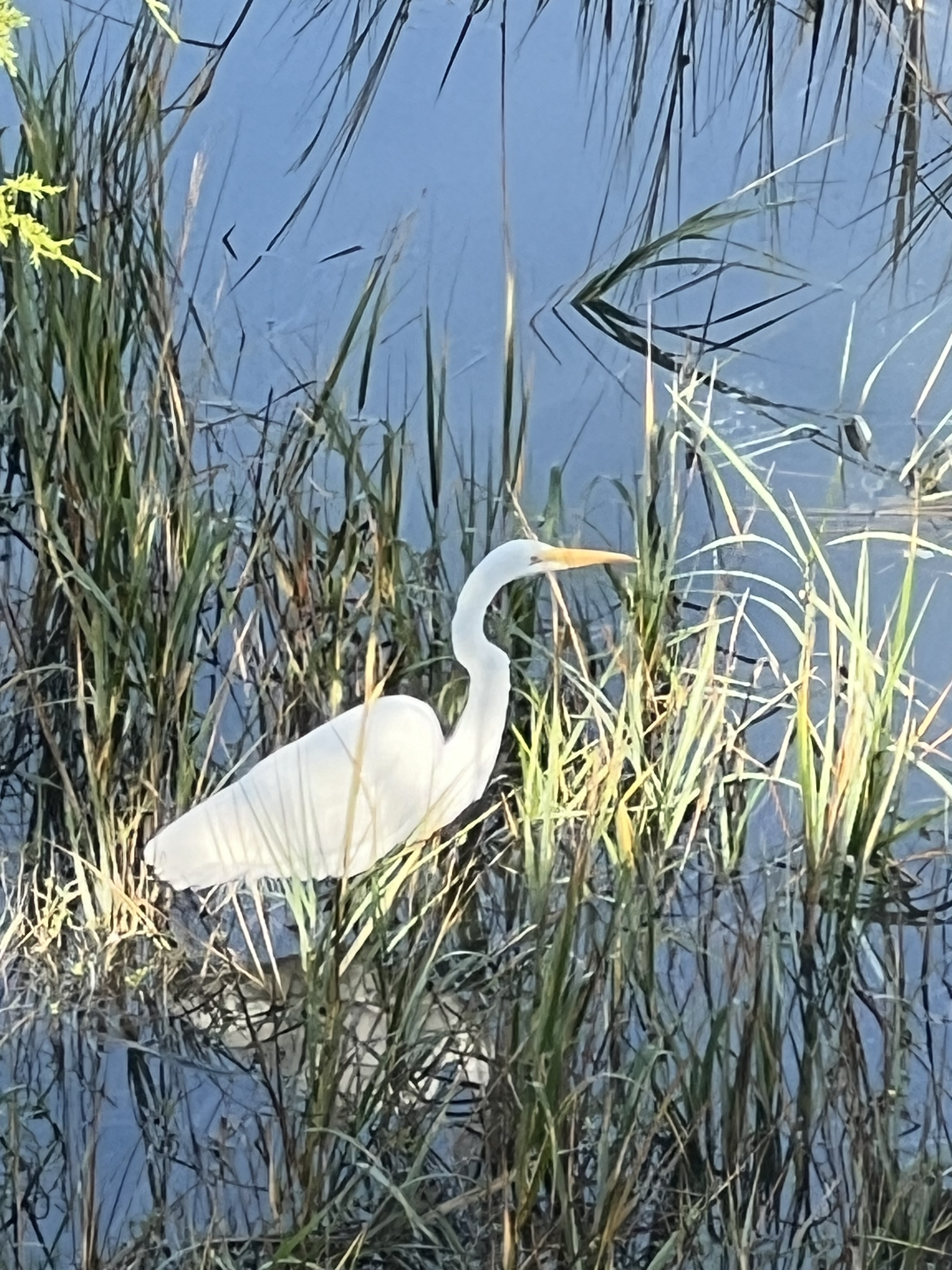
Herons and egrets abound.
Standing statuesque for long minutes,
then slowly moving on legs like stilts,
gracefully hunchbacked,
their long necks extended, then coiled,
their sharp beaks ready.
They have eyes on the side of their head
and can see behind them. When stalking
prey they move their eyes forward,
focusing them like binoculars.
The head cocks when prey is sighted.
A hapless little fish or crustacean.
The strike is lightning quick.
The tail of an eel squirms
before it is quickly swallowed.


All this life, the plants, the animals,
the birds, and the land itself, the
not so ‘terra firma’- is the result
of millions of years of the ocean
rising and falling, the tide constantly
ebbing and flowing, the beach
being formed by pulverized rock,
transported by rivers from eroding
inland mountains, and the formation
of the marsh itself by accumulated
silt and other detritus.

As I stand on the edge of the marsh
that extends for miles as far as the
eye can see and beyond, I realize
my presence here is so very short.

The house I live in, despite being on
stilts, will inevitably wash away in
a cataclysmic hurricane. The crumbling
concrete foundation left behind may
last, maybe a hundred years?

I fear my own existence in terms of
cosmic geological marsh time
will not be that much longer
than a sand gnat’s.

I think these thoughts as I swat one
of the little buggers.

On to the next life you go.
I will follow soon enough.

****

Less elegant than the
egrets and blue herons
but also abundant are the
clapper rails. Their appearance
leads some folks to believe
they are related to the
chicken.
(See Audubon’s Clapper Rail Salt Water Marsh Hen – Plate 310)
Called “marsh hens” by the
locals, these rails seldom
reveal themselves
but they can be heard,
clacking and calling.
They make a big racket when
communicating with each
other or when disturbed.
You can definitely hear them
but don’t often see them.
(Best time to catch a glimpse
of them foraging: not long
after sunrise at low tide.)

The marsh hens mate in spring.
There is a rush of activity as the males
scramble to build nests in the perfect spot,
a mix of grasses, tall and short.

Then there is the kingfisher.
It looks like a large demented
woodpecker. Squealing,
clacking and screeching
to claim its territory, it dives for fish,
spinning like a jet fighter. The female
boasts brighter plumage than the
male and they sometimes nest
in burrows.
****
The tide goes out and yet again
the oyster beds are revealed,
standing in tight reef-like clusters
scattered in the exposed mud.
Wood storks search for food
in the muck and shallow water,
gangly on long legs
that support a large body,
sweeping their heads
back and forth as if grazing.
They sometimes travel alone,
sometimes in pairs,
sometimes in a group.
They congregate in big pine
trees and linger, sometimes
for hours. They prefer to nest
in more inland cypress swamps.

They are not everyday visitors
and are considered endangered,
thus their appearance prompts
me to grab my binoculars.
Up close, the wood stork is
rather ugly, it’s head more
like a turkey’s than a heron’s.
But in flight, its long legs, neck
and black tipped wings fully
extended, its body perfectly
aerodynamic, it is
spectacular to behold.

Anhingas like to perch
on my neighbor’s dock.
They spread their big
black wings like Dracula’s
cape, but unlike vampires,
they seek the sunlight.
This is not exactly how Audubon
might describe an Anhinga
but they look like a cross between
a cormorant, a loon and maybe a vulture.
Audubon noted that Anhingas
were called “Snake-Birds”
because their long necks
resembled a serpent’s body.
He depicted them in graceful
yet exaggerated courtship.
(See Plate 420)
Jays are large birds and raucous.
They don’t like to wait their turn
in the bird bath. Mockingbirds are
another rambunctious – and
vociferous – visitor to the bird
bath. They seem to be
announcing ‘here I am’ to
prospective mates.
****
The old confederate jasmine
growing in our yard
has become a monster,
it’s massive root base
looks like a twisted anaconda
escaped from the Everglades.
It has taken over a good part
of the deck and blankets
a decrepit fence that would
collapse if not for its clinging
vines.
In spring and summer the
jasmine blooms white flowers,
gushing a heady perfume.
It is not native, has nothing to do
with the southern confederacy
and isn’t really even a true jasmine.
But it has found a home
near the marsh where it thrives.
****
The clouds roll in, massive
cumulonimbus thunderheads,
laden with moisture…
The rain falls, at first a few
drops, then it pours,
drenching the swaying
spartina – also called
cordgrass.
It soaks the yellow
flowering sea oxeye,
a prolific plant with
fleshy blue/gray and
green leaves that
grow on bending stalks
in dense two or three
feet high clusters
crowding the edge
of the water.
The downpour pummels
the trees, gathering in
rivulets in the exposed
mud.
You can almost hear
the thirsty plants sigh.
Thunder rumbles.
The birds hunker
down, going silent.
The deluge continues
long enough for the
frogs to start singing.
Ecstatic.
When the downpour tapers off
some raccoons venture forth,
enjoying the fresh rainwater
puddles as they forage in
broad daylight.
The sky gradually clears,
as does the mind.
Cleansed, refreshed.
At twilight, hungry bats appear,
diving and pivoting in pursuit
of their oblivious insect pray.
The insects are invisible to my eye,
but appear innumerable to the
gorging bats.
(Did I mention bats eat bugs?)
Box turtles are not aquatic
but terrestrial. They can move
rather swiftly. Not rabbit swift.
But they can crawl across a driveway,
then traverse a back or side yard
in short order. How they survive
where humans have paved
and fenced the land, it’s amazing.
I must try to remember
to look under the car
to make sure a turtle
isn’t loitering there when
I pull out of the driveway.
Meanwhile, in the spring,
the nearby highway that
crosses the marsh is littered
with the shattered carapaces of
female terrapin turtles,
crushed by cars as
they migrate in mass
to mate and nest.
The spiders in spring are small.
Then they grow bigger
and bigger. Their webs are
everywhere. In the trees,
the bushes, blocking access to
the garden hoses. Boobytrapping
doorways.
Spring has brought plenty of
bugs for them to eat. By the
end of summer some of them
will be the size of a small child’s
hand.
But they eat the bugs
and the bigger they get
the bigger bugs they eat.
(Did I say they eat the bugs?)

Competing with the spiders
for precious real estate
in the carport are wasps,
mainly mud and paper wasps.
They feed on caterpillars and
aphids and seldom sting
unless provoked. (These
are wild creatures.
Sometimes your mere
presence is provocation
enough.) The wasps
also sometimes find
themselves trapped in a
spider’s web.
(Did I mention they also eat bugs?)
****
Thoreau said: “In wildness is
the preservation of the world.”
Our section of the marsh is
not wilderness, but the marsh
is still a wild place. Not as wild
as it once was. You know that
when you see dolphins taking
advantage of high tide to do
some fish feeding in the marsh
having to dodge people buzzing
about in power boats.
Still, I suspect the marsh will be
here, along with many, if not most,
of the creatures that inhabit it,
long after we and our motor boats
are gone.
A few of us humans may still be
around, returned to hunter-gatherer
status, skulking about,
competing with the birds,
the raptors, the snakes, the
rodents and raccoons for fish
and crabs and shrimp.
Maybe it will be paradise
again.
Next: Part II
Summer

Posted August 2025
Leave a Reply