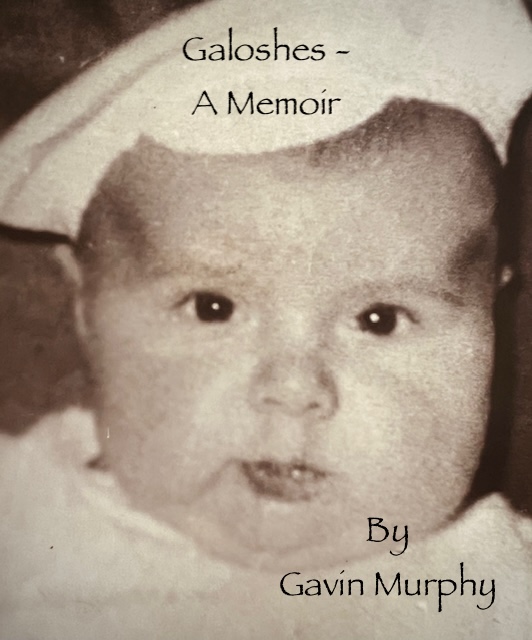

Galoshes – A Memoir
PART VI
By Gavin Murphy
My interest in reading – and writing – started when my dad, who like I said was not a big fan of television, encouraged me to read books, mostly the classics. Our Lady of Fatima also had a school “book club.” This was basically a school fundraiser but I came up with half dollars to order paperback classics, from Swiss Family Robinson to Huckleberry Finn. Somewhere I got a copy of Tarzan of the Apes, complete with an ape/English glossary. The club offered up more – then – modern fare as well, including Howard Fast’s revolutionary war saga April Morning and the classic western Shane – the inspiration for the great movie western of the same name starring Alan Ladd. (I don’t think the good sisters read many of these books before marketing them to us.)
My dad knew I was interested in nature and animals and the wilderness in general. In addition to presenting me with a copy of Never Cry Wolf by Farley Mowat he also got me a copy of The Big Sky, A.B. Guthrie Jr.’s depiction of mountain men, and not really a book for kids but a raw and honest look at a hard life.

My dad was a voracious reader, mainly non fiction, and he kept up with contemporary voices. When I saw him reading Hells Angels by Hunter S. Thompson, I was drawn by its paperback cover featuring an outlaw biker sporting the motorcycle gang’s colors, with the distinctive winged death head. When I expressed interest, dad pronounced the book was unsuitable reading for a 13 year old. Of course I knew exactly where he would hide it – in his chest of drawers – so I was able to skulk into my parents’ bedroom and read most of it in quick takes sitting on the edge of their bed.
By now I ran with a gang of guys I knew from school and the scouts and the football team. We would hang out on various street corners, drink soda, smoke cigarettes and look for stuff to do. I had a paper route and was making money, so I could afford to buy myself hoagies and pizza and I had started buying my own clothes, because my parents wouldn’t buy me what I wanted to wear.
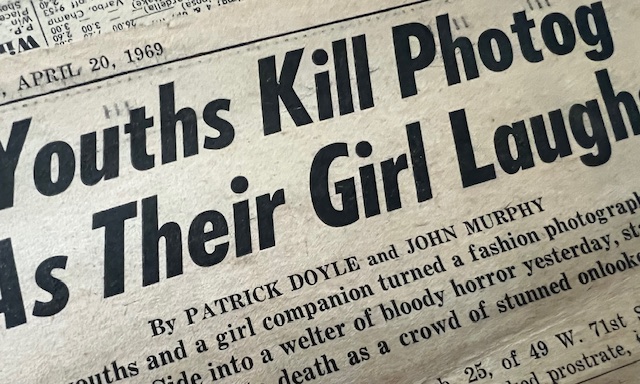
I delivered The Bulletin, which then was the dominant paper in the market. The Bulletin was an afternoon paper, so I only had to get up early on Sundays. The Inquirer, where my dad worked, was a morning paper, which was probably one reason why it survived in the long run and the Bulletin eventually folded.
I got the paper route from a friend, when he got a job making more money as a golf caddy. For awhile I hired my brother Tim, at a buck a week, to help me deliver the route, which included an apartment complex that bordered the other side of the creek, over which I had to haul 60 papers or so in order to get to it.
My brother and I found an unused storage locker in the basement of the apartment building and turned it into our “office” complete with a padlocked door. We furnished it with a discarded easy chair and stored stuff in it, not just newspapers but scavenged comic books and magazines, including the occasional Playboy discarded by one of the swinging single guys. On a cold day we would retreat there to warm up and read, while we rested. On Fridays we counted the collection money and that also was payday for my brother. (To this day he claims I underpaid him.)
The official “branch office” where I picked up the papers after school was in a garage that the Bulletin rented from somebody in the neighborhood. The branch was managed by a teenage kid, so there was no adult supervision. The delivery guy was often late in getting the papers to us. We took to playing cards while we killed time waiting for Cosgrove to arrive. Usually we played five card poker for pennies, nickels and dimes. Cosgrove drank and when he finally showed up would swear at us as he tossed the bundles of newspapers off the truck.
It wouldn’t take long before those who rented the garages to the Bulletin tired of having 20 or 30 teenaged boys hanging around for hours seven days a week all the while gambling, doing wheelies on bicycles, swearing, fighting and littering the place with empty soda bottles and Tastykake wrappers. So they would kick us out and ultimately we ended up on just a dirt lot in an alley, with a heavy wood table, and a few trash cans for the snapped wires the bundles came wrapped with and for leftover inserts and other junk.
Cosgrove was getting later and later with the deliveries, and surlier and surlier. One day it rained, and since we had no protection from the elements, our mood was becoming pretty foul. To pass the time waiting, we gathered up a bunch of old bundle wires and pieced them together into a long metal rope. We fashioned a sturdy hook at one end and attached the other end to several trash cans in the alley. We then camouflaged everything with old newspapers.
Finally Cosgrove showed up, drunk and nasty. He tossed the bundles onto the wet ground, then got back into his truck. Before he could pull away, the hook came out and was attached to his back bumper. He gunned the truck and took off down the alley with three or four trash cans bouncing along behind making a terrific din and spilling garbage everywhere. He went a block before he realized what was happening. Then he stopped the truck and got out, shaking his fists at us and screaming. We shouted that he was an asshole and took off on our bicycles.
We did the occasional good deed, as when the school decided we should write letters to our boys fighting in Vietnam. Names and addresses of soldiers were passed out in class and we dutifully wrote them letters that told them we thought they were doing a great job defending God and country. The letters were mailed off and forgotten when, after several weeks, I received a reply to mine.
The letter was from a PFC A. Lynch, who was assigned to the 580th Sig. (Const). He thanked me for writing to him and enclosed some Vietnamese currency in the envelope. I took the letter and the money to school and showed it off. I think I was the only one in class who ever got a reply. I wrote PFC Lynch another letter but this time there was no answer. For a while I worried that something might have happened to him. Years later I looked for his name among those listed killed in the war and was relieved that I didn’t find it.
We were all getting more into music and caught up in the counter culture ideas and yes, fads, that marked the era. We also were fans of Bill Cosby, listening to his comedy albums. Riiight! (He was a Philly guy.)
It was around this time in the late 1960s when my friend who knew a lot about music took me into his bedroom and pulled a small portable record player out from under his bed, saying he had something he wanted me to hear. He pulled out a 45 rpm record and slapped it on the small turntable: Bob Dylan’s Like A Rolling Stone.
I had never heard anything like it. For one thing it was long. (More than six minutes.) And it was more like a poem than a song. The lyrics more spoken than sung. It wasn’t a love song either. It had been out for a while but I had never heard it before. Apparently it wasn’t getting played on the AM radio stations I listened to. Up until then I had listened to music on a small transistor radio. I realized I needed to get a record player so I could get records like A Rolling Stone and listen to them over and over if I wanted.

(The Bazaar of All Nations, a prototype shopping mall on Baltimore Pike that we hung out in, had a pretty cool record store. We spent a lot of time browsing there looking at record covers and such – I particularly remember the cross dressing cover to Frank Zappa’s album satirizing Sgt. Pepper’s called “We’re Only in it for the Money.” Nothing, not even the Beatles, was sacred to Zappa.)
Of course I wanted to grow my hair longer. I didn’t expect to be allowed to have a mop hanging in my eyes like Brian Jones from the Stones, but I thought something more than a small pompadour should be permitted. It was not. I was sent to the barber with strict orders to “get it all cut.” I was no longer the kid from California with the buzz cut but my hair was not much longer than that. We boys were pretty much all trying to achieve a longer hair style, no longer pasting said pompadour in pomade like a wave rising above our foreheads, but letting it droop naturally toward our eyebrows. This was pretty much met with outrage from the authority figures, including the sisters at school, and barbers were caught in the middle, knowing the parents wanted a shorter cut than what the kid sent on his own was requesting. It took years for my dad to relent and stop bugging me about my hair being too long, which after a while, in my late teens, it probably was.
We adolescent suburb dwellers we’re not unaware of the latest fashions hopping across the pond from Carnaby Street and elsewhere in the mod world. I recall trekking with my friend Steve Patton to the local Robert Hall, at the time a well-known mass merchandiser of men’s clothing, so he could purchase a Nehru jacket, then in the height of style as they were worn by the Beatles and hip cats like Sammy Davis Jr. Not everyone could pull off this look, but Patton could, looking about as cool and hip as you could for an eighth grader.
After almost four years at Fatima, I had made some good friends by now and was settling in and even thinking about high school. So of course it was around this time my dad decided he had enough of Philadelphia and the East Coast, and it was time to get back to his Midwest roots. He managed to land a job in Milwaukee at The Milwaukee Journal. This was not far from Chicago and Peoria and our relatives, so it would bring us all closer together again.
He left to start work at this new job and we were left to tell our friends goodbye and wait for him to find a new rented house and send for us. I told my friends I was moving and they held a surprise going away party for me. They gave me a new radio as a going away gift. I was touched by this and sad to be leaving. It had taken me years to make the good friends I had. I even had picked up some of the local accent (but I still said wah-ter not wu-ter).
Then after a couple weeks word came from the old man in Milwaukee that he was having second thoughts about the new job and the move was off. I had to tell my friends – uhh – I’m not moving after all and I asked if they wanted the radio back. They gave me some guff but didn’t confiscate the radio.
I remember the evening when himself returned from Milwaukee. I was seated at the dining room table with my mom and brothers and sister having supper, when I noticed the door from the basement open a crack. The old man was there and when he saw that I had seen him, he put a finger to his lips for me to be quiet. I could tell he had been drinking, and I knew this would not impress my mother, especially after his being gone for weeks. Then he opened up the door and everyone screamed Dad’s back!

Dad apparently couldn’t get or didn’t want his job at the Inquirer back, so he ended up taking a job for a newspaper in Pottstown, a much smaller paper than the Inquirer, to which he had to make a pretty long commute, which he hated because he didn’t like to drive.
Eighth grade was pretty much like seventh grade. We were so skilled at subversion now that we could play covert games of poker at our desk without the nuns knowing it.
Apparently wanting to know just how smart or stupid we really were, the school administered a standardized IQ test. When the results came in, we were lectured about not living up to our potential. Then, in what must have seemed like an inspired idea to the nuns, we were seated in class based on our IQ scores (I’m not making this up). They explained that, based on what brains God had given us, this is how we should rank in class. As with the reading test in sixth grade, this test haunted me because it showed I had a high IQ (but not genius level). I was now seated either first or second in the first row based on my IQ, even though I ranked thirteenth or so in the class based on grades.
One highlight: We were CYO league champs in football that year and all of us on the team got red jackets, as Fatima’s uniforms were red. When we hung out on the street corners in these jackets we became known as the red coats. (I played first-string tackle. We were undefeated in eleven games.)

We were all growing rapidly and this was becoming especially noticeable among the girls. I never understood the logic behind the girls’ uniforms. The skirts didn’t do a very good job of hiding anything and despite constant inspection and policing by the nuns, some girls always managed to keep their hemlines above the knee. Some families simply couldn’t afford to go out and buy new uniforms for their kids when they suddenly spurted an inch or two. By eighth grade it made little sense to do so when the kid would soon graduate anyway. So some of these uniforms got very tight fitting as the year wore on, with every quarter inch of growth and expansion becoming more and more obvious.
This seemed to greatly perturb the nuns, who could tell which girls were on the verge of serious puberty. These girls seemed to be selected for special attention as to skirt length and so forth. Some girls at 13 years old were much more mature than others – certainly more mature than the boys – and the nuns could tell this as well. It was fascinating to follow the conflict of strong wills between a defiant eighth grade girl, and a nun, especially since the nuns couldn’t use the same methods of discipline so summarily applied to the boys.
Our interest in the opposite sex was increasing. We followed girls around the Bazaar.
One time I decided to purloin some whiskey from an opened bottle that my dad had put in a kitchen cabinet and not yet consumed the rest of. I poured some of it into an empty pipe tobacco can and smuggled it to a friend’s house whose parents were divorced and whose mom worked. It tasted like crap from the tobacco residue and there wasn’t enough for us to get inebriated from. Unfortunately for me it was around the holidays and my grandmother was in town. She had observed me in the act of stealing the whiskey and reluctantly ratted on me to my parents. I didn’t feel much remorse about deceiving my parents but I did feel bad about creating a dilemma – to tell on me or not – for my grandma because it was obvious the affair upset her.
That summer when I had told my friends that I was moving to New York because my dad had a new job there, the announcement was understandably met with some skepticism. It hadn’t been that long since I was supposed to move to Milwaukee and hadn’t.
In fact my dad had been working for the New York Daily News for months now, commuting from Philadelphia to New York City every day. Once he had gotten sick in New York and took the train all the way back to Philly before he was taken to the hospital for an appendicitis. Fortunately, in those days an appendicitis didn’t bankrupt you because you didn’t have health insurance, which we didn’t have as my dad hadn’t been employed long enough at his new job to be covered.
So there was no going away party this time but this time we were really going. Moving again to another state, going to a new school and making new friends.
I would stay in touch with my friends in Philly. We wrote letters in those days. I would even visit them from time to time.
The guys did show up on the day of our departure to say farewell and to make sure that I really was leaving this time. I remember them sitting on the curb, watching as we pulled away, driving this time in dad’s car to what would be our new home – a place called Long Island.

Postscript
Every year in the spring I think it was Fatima held a carnival in the school parking lot with rides and all kinds of chance games and other gambling. One of the most popular booths was the record booth. Philadelphia was a soul music city, but rock also was big and getting bigger among us middle class white kids. The dilemma in 1968 if you won something at the record booth: whether to choose Sgt. Pepper’s Lonely Hearts Club Band by the Beatles or The Four Tops Greatest Hits.
I think it was just after carnival time that word spread through the neighborhood that Bobby Kennedy, running for the Democratic nomination for President in 1968, would make a campaign stop that evening in the Fatima parking lot/school yard. I recall him as a slight figure in a suit, waiting in the dusky parking lot for people to approach him. I stood at a distance and never did shake his hand. I don’t remember a lot of security around him and he seemed very alone standing there with a few people milling around. A few weeks later he was dead.
I’ve tried to verify that this visit actually took place by researching online and found that Bobby was in Philly around this time, but I haven’t found anything about Bobby being in the school parking lot at Fatima. Sometimes I wonder if I really did see him, or I just dreamed I did.
This seemed the logical place to conclude a memoir about childhood and I thank you for reading it.
Posted August 2024

Leave a Reply