
A Short Story
By Gavin Murphy

From his shrine-like tomb on a pine-shrouded knoll, D.H. Lawrence looks out over a wide blue valley. Sara and I stand before the grave atop a sienna slope above the ranch once owned by the famous writer. Taking its turn in the restless New Mexico sky, the sun warms the shrine’s whitewashed walls. A dry wind chases red dust around our feet.
Frieda Lawrence lies buried near the entrance to her husband’s crypt, in a grave marked by a headstone. Sara stares at Frieda’s dry brown plot. “Poor Frieda, she’s kind of just stuck there, like an afterthought, like a wife buried at the foot of her pharaoh.”
Sara is wide hipped, with a flat stomach, ample breasts and trim buttocks. She has glossy black hair, curled in tight ringlets, and a round face with large brown eyes. Her lips are full and dark, like overripe fruit.
“Spoken like a true anthropologist,” I say.


We step through a doorless portal. A small round window projects diffused daylight into the dusky chamber. The hard floor is painted gray, with animal droppings here and there. Yellow paint on the walls peels at the edges. A bird’s nest sits in a cracked ceiling lantern. A large fly, annoyed by our intrusion, buzzes indignantly.
Behind a low railing and carved wooden gate is a headstone like an altar, inscribed with the letters DHL. Perched atop the headstone is a statue of a Phoenix, mythological symbol for rebirth, and Lawrence’s personal talisman.
“Not exactly a major tourist attraction,” Sara whispers. “No wonder nobody knew how to find the place.”
“Hey, I’m an English teacher, remember? I dig this kind of thing.”
Sara focuses her brown saucer eyes on the headstone. “Lawrence was English wasn’t he? How did he end up here?”
“He thought New Mexico was a mystical place, an antidote to the social constraints of civilization,” I reply pedantically. “When he died in Europe, Frieda had his ashes brought back here, though some say his ashes aren’t really here, but that’s another story.”
“I only read Lady Chatterley’s Lover,” Sara says.
On a stand is a spiral notebook registry with the dozen or so signatures of that day’s visitors. One has scrawled: “David, where are you now when we need you?”
“Can we go now?” Sara pleads.

We sit in silence in the rented car on the drive back to Taos. Sara is at the wheel. I stare out the window at the scenery scrolling past. Tall mountains crowd the horizon, bunched together in a mass beneath a curtain of brilliant blue. Adobe-style homes dot the landscape, scattered here and there or stacked beside one another in ersatz adobe-walled subdivisions. Occasionally there is a genuine old adobe building. Sometimes wrecked and rusting automobiles adorn front yards like avant garde artworks. To the west is the great gorge of the Rio Grande River, a ragged incision in the sunbaked desert.

Finally, Sara says: “Maybe this trip wasn’t such a good idea. I get the feeling I’m keeping you from doing what you want.”
“Or do you mean I’m keeping you from what you want?”
“Don’t twist my words back at me. It’s annoying. You know what I mean.”
“You know, Lawrence saw the relationship between a man and woman as a constant struggle. Not just a mind game. But a profound struggle for sexual power, for intimacy, for love.”
“So, what does that mean?”
“It means we’ll go to the Pueblo first thing tomorrow. I just wasn’t ready for it yet. It seemed so touristy.”
Sarah rolls her eyes. “Touristy?” she echoes sarcastically.
“Look, I’m sorry for dragging you out to a grave our first afternoon in Taos.”
“It was kind of morbid.”
Dark clouds suddenly sweep over the mountains, casting long shadows that duel with golden patches of sunlight. The air hangs heavy, charged with electricity. A thunderclap rolls across the desert and the road shudders. Sara grips the wheel with white knuckles. “It’s so dramatic here,” she says.

I reach over and rub her shoulder. “You need to relax. I know, we’ll stop at a bookstore in town – there’s enough of them – I’ll pick up a copy of Lady Chatterley’s Lover. We can read to one another while we’re naked in the hot tub.”
“I love it when you read to me.”
Then, in a sudden shift of mood Sara is so capable of, she says, “Where do you want to eat tonight?”
We feast on enchiladas, blue corn tortillas, chile verde sauce, and sopaipillas, fried bread served with honey. Several drinks later we are reeling, arm in arm, across the dark plaza.
“One thing so amazing about this place is…”
“Yes? Tell me…” Sara tilts her head in mock anticipation, her eyes soft.
“Think about it – when explorers were just beginning to try and hack out a settlement on the wild shores back east, chewing on bark and dropping dead like flies, the Spanish had villas and servants and ponderosas set up here.”
“I thought I was the anthropologist.”
I spy the pueblo exterior of the old Hotel La Fonda, its entrance facing the plaza.
“Let’s stop and see the paintings.”
“What paintings?”
“The D.H. Lawrence paintings.”
“He painted too?”
For a dollar, the night desk clerk agrees to show us the paintings. He is a short, muscular man with slick black hair and a pocked face. He leads us through the dimly lit lobby of the old hotel. We enter a small office used by the owner, where the canvases are crowded together on the walls, along with old photographs and other art works.
“Scotland Yard banned these paintings, back in the twenties,” says the night clerk. “They’re pretty tame by today’s standards.”
In one painting, muscular nudes grapple in a crowded fleshpot. In another, a goateed man wraps his arms around sagging female breasts. Lathering wolves rip his flesh. Lawrence himself, with a blue beard, smiles as satyrs wrestle with plump amazons.


“Lawrence was a great author, but not a great painter,” the desk clerk volunteers.
“I don’t know,” I say. “Some scholars think he could have made it as a painter if he had started earlier.” I turn to Sara. “What do you think?”
Sara studies the paintings with eyes that analyze and categorize, but betray nothing. She shrugs.
Arm in arm, we weave down the narrow sidewalk. Sara speaks.
“Those Indian women, the ones practicing for the Native American mass at the cathedral back in Santa Fe, they looked so happy singing those Christian hymns in their own language. Almost as if it didn’t matter being forced to convert to another faith.”
After a moment of silent contemplation, she adds, “I think I liked Santa Fe better than here.”

She did seem happier in Santa Fe. Even when it rained and the artists in the park covered their paintings and the quartet performance of Vivaldi at the Museum of Fine Arts was sold out. We found shelter in a snug bar at the Hotel St. Francis. Sara sipped on a Bloody Mary garnished with a chili pepper. We watched as the tourists outside sidestepped puddles from the downpour.
Later that evening, after the rain stopped, we stumbled across a monument to the burro, complete with a plaque declaring the importance of the jackass to New Mexico. We laughed so hard we had to hold each other up.


She was happy in Santa Fe, after our first night in New Mexico, when she seemed sad. There we were, two teachers from Los Angeles, together in a hotel room in Albuquerque. From our window we could see the Amtrak Station below, a stop on the old Santa Fe line. It looked abandoned in the darkness. I thought she might cry. But later that night, back in the room after a couple of drinks in the bar, she wrapped herself around me and drained me again and again, until I no longer had the strength to resurrect myself.
“I don’t know,” I say. “I like it here. Taos seems more – genuine.”

At Taos Pueblo, feeling fuzzy from the drinks the night before, we join a crowd of people waiting for the tour. Several in the group hoist video cameras onto their shoulders, while others clutch maps and travel brochures. It is a brilliant morning, already hot, and the sun warms my face and forearms. When our guide appears, she is a beautiful young Indian woman, dressed in native garb. Her name is Maria.

Maria leads our group through dusty courtyards and narrow lanes, where her people have lived for maybe a thousand years. To this day there is no electricity or running water in the ancient terraced dwellings. There is only the sacred shallow river, from the banks of which the pueblo rises.

We pass the ruins of a church, a heap of adobe that looks like a sand castle dashed by a rising tide. A clutter of wooden crosses bristles in the churchyard cemetery, where the natives bury their dead wrapped in blankets, so as not to trap the soul. Maria explains the church was first destroyed in the Pueblo Revolt against the Spanish in 1680. It was rebuilt, only to be sacked again by the U.S. Cavalry in the War with Mexico.
“Now, this is interesting,” Sara says.

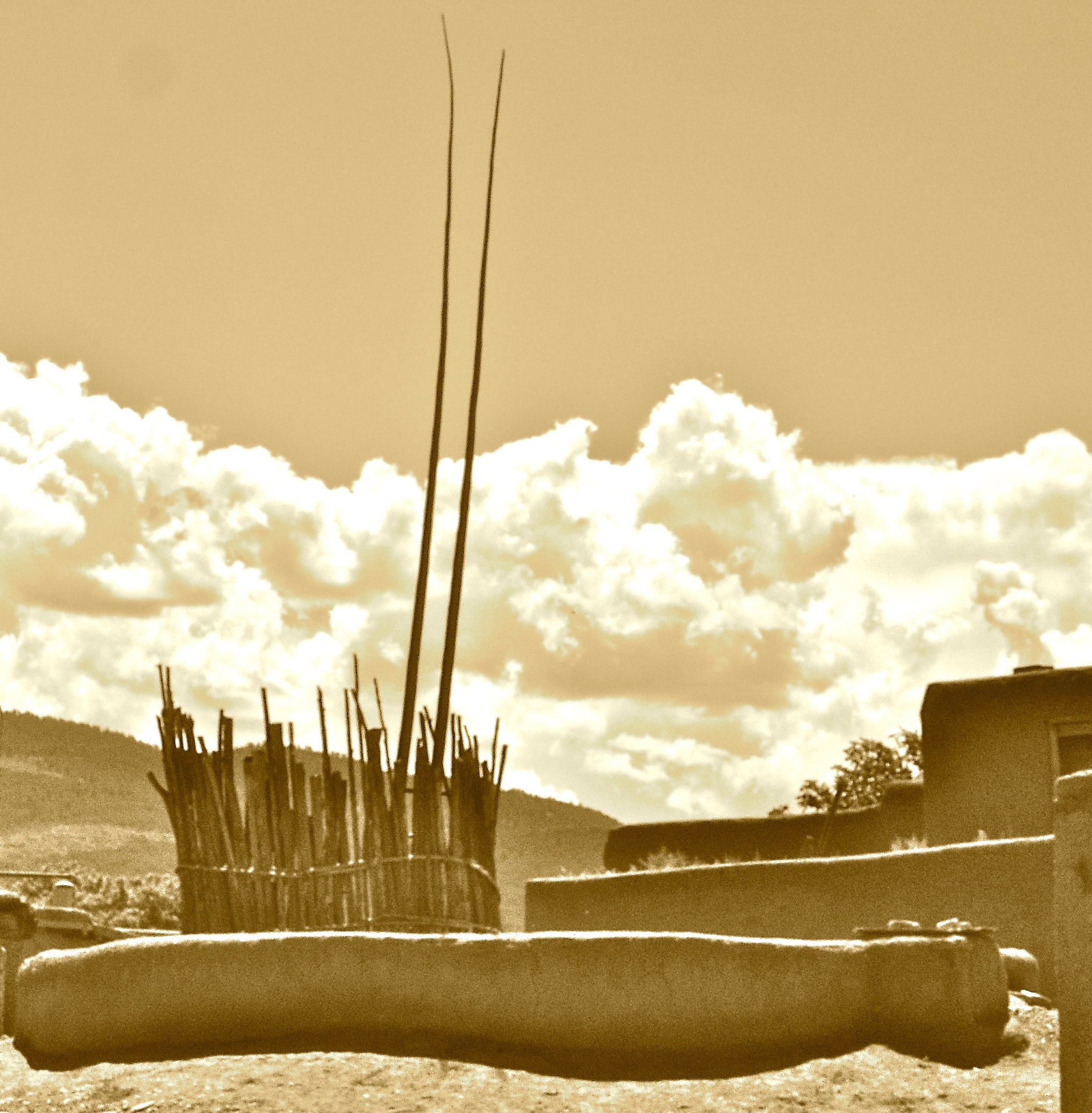
We pass igloo-shaped outdoor ovens and wooden barriers that keep tourists from getting too close to the kivas, round structures burrowed into the earth where religious ceremonies are held. To get inside the kivas, the Indians descend tall tapered ladders, the ends of which pierce the sky above.
At the end of the tour, Maria accepts tips from the group, maintaining her dignity by keeping her hands discreetly to her sides as she takes the dollar bills.
“I’m embarrassed for her,” says Sara.
“Yes, it’s sad to see a noble native denigrated by commercialism,” I say. “But she’s no more demeaned than anybody else.”
“Feeling cynical today are we?”
“No more so than usual.”
For a moment, she is angry with me. Then she musters some enthusiasm from the fading moments of the morning.
“Let’s go whitewater rafting this afternoon.”

The Rio Grande river is shallow during summer, slow running, sometimes even meandering. We are in a large raft with a family from Kansas. The raft glides in gray water that gushes through the deep gorge. We drift peacefully, past green tufts of junipers and interloping tamarisk trees on the shore. Then the raft heaves and pivots. Churning water leaps and tumbles around us. Invigorated by the cold wet, we shout and wave our paddles like fish fins out of water.
Damp curls gather around Sara’s face. Her teeth shine and her skin glistens, like polished marble in sunlight. She is not just a school teacher now, but a river angel, her womanhood full and ready.
Later, back on shore, our tour guide runs to fetch the van to take us back to Taos. Sara and I watch in silence as the sun sinks beyond the top of the gorge. She stares at the vermillion canyon walls and a giant slew of crushed black rock slowly sliding down. She is tired now, and she shivers as a dry chill descends from above. I put my arm around her.
“You can see why they call it the Land of Enchantment.”
Sara makes no reply. She is tired. Tired of the game, the struggle.
Early next morning we head north, where we have found a summer bargain rate for a condo in Taos Ski Valley. After hauling our suitcases in from the car and loading some food and wine into the refrigerator, we rest on the sofa. The muffled sound of rushing water drifts through the open windows. I suggest a hike before lunch.
“You go ahead,” Sara says. “I think I’ll just rest.”
“What’s the matter?”
“I don’t know. I feel very tired.”
“It’s the altitude, you’re not used to it.”
“How high are we?”
“About eight or nine thousand feet.”
I notice her face is flushed, her eyes moist.
“I feel like I can’t breathe,” she says.
“Get some rest,” I say. “You’ll feel better later.”
Sara curls up on the couch, like a child preparing to take a nap. I stroke her head gently for a moment, then I head for the kitchen, where I fill a canteen with cold water. Forgetfully, I let the door slam behind me as I leave.
The trail ascends at a steep angle beside a brooklet of cold water. The rain of recent days has spawned a riot of green growth. Fresh toadstools, like tiny puffed up umbrellas, sprout from moss-embossed trees and logs. Yellow and purple flowers blanket sections of the ground where sunlight falls through the canopy.
After only a half mile or so I have to stop and rest my heaving lungs. A cool zephyr descends from the peaks, like the breath of the sky and mountains, bringing with it migrating plant spores and a heady perfume of summer. From overhead comes the vibrato caw of a raven. I look up, but the sunlight blinds me and there is only a shadow.
The raven is gone and the only sound is the steady din of migrating water, cold and relentless. I stare at the stream and think of Sara. I think of D.H. Lawrence, brooding in the wild New Mexico shadows, a footnote on a Taos tour map. Lost to the sexual mystery.
Then there is the crunch of my hiking boots on the rocky trail and the solitary refrain of a flatlander panting alone in the thin air of a mountain morning.

Posted July 2025
An earlier version of this story received an Honorable Mention in the Literary Short Story category of the 1994 Writer’s Digest Magazine Writing Competition.
Leave a Reply